Deterministic
Same account, same findings. Every dollar comes from resource state and AWS list prices, never a guess.
Connect one read-only IAM role. In under 3 minutes GhostTrace lists unattached storage, idle compute and abandoned databases, each with its annual cost. Metadata only, never your data.
Most tools read CPU graphs and suggest downsizing. GhostTrace checks attachment state, listener ports and cross-service dependencies first, then puts an annual dollar figure on each finding.
Same account, same findings. Every dollar comes from resource state and AWS list prices, never a guess.
Unattached volumes, idle instances, zero-connection databases and orphaned snapshots.
See what depends on an EC2 or RDS resource before you delete it.
Public buckets, unencrypted volumes, open RDS endpoints and untagged resources.
Seven static-analysis passes over your metadata. Each one targets a specific class of waste.
Storage, compute, database, serverless, logging, and cross-service architecture — every pass runs from the same read-only role. Scroll to walk each one.
Single-resource scanners look at one thing at a time. This pass reads across the account to catch spend that works correctly but wastes money by design: idle plumbing on an hourly meter (ALBs with no targets, idle NAT gateways, unattached Elastic IPs), missing S3/DynamoDB VPC gateway endpoints that route traffic through NAT, and over-provisioned ElastiCache or low-value CloudFront. Hard savings where a charge is provable; advisory flags where it isn't.
Need a specific AWS service audited? Tell us what to cover next.
The output is a report, not a chart. Every row is a resource, a dollar figure, and a dependency map.
Each finding carries a quantified annual cost, a blast-radius dependency check, and a concrete remediation. These are views from an actual assessment run.
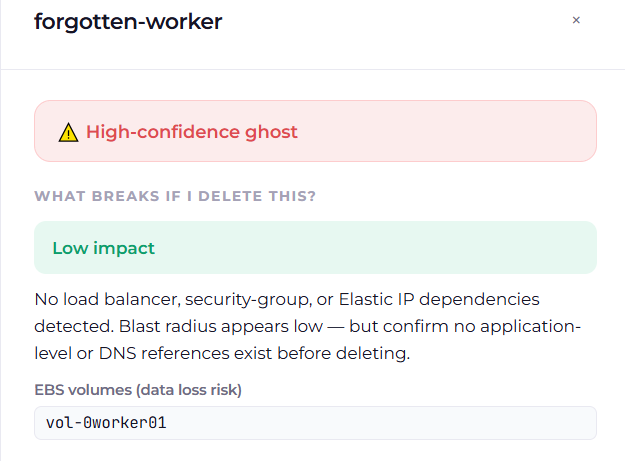
Before you touch an instance, see the real dependencies — load balancers, security groups, Elastic IPs, and volumes that hold data — graded low to high impact from read-only signals.
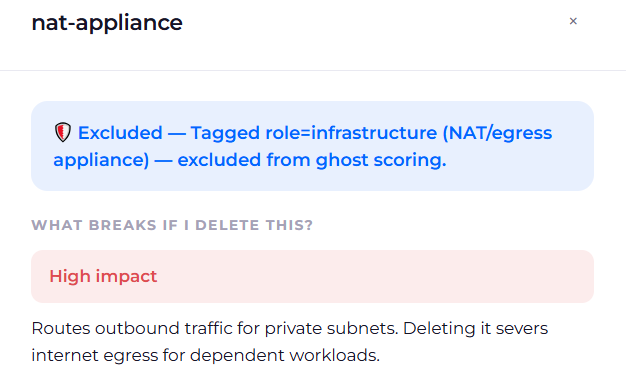
Role inference and tags exclude NAT appliances, bastions, and DNS boxes from ghost scoring — and still warn you that deleting one severs egress for everything behind it.
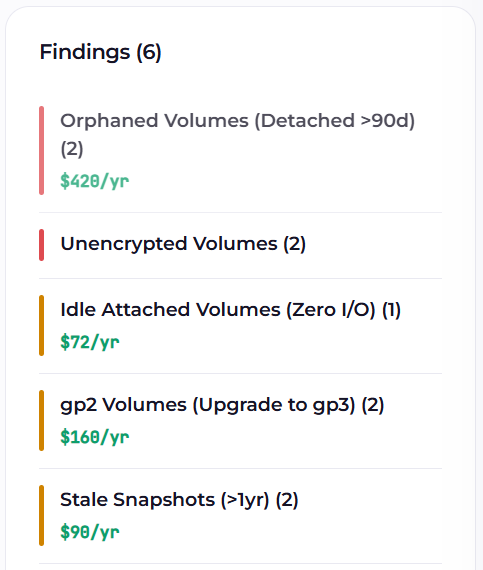
Orphaned volumes, idle disks, gp2→gp3 upgrades, and stale snapshots — each with the exact annual saving attached, highest impact first.
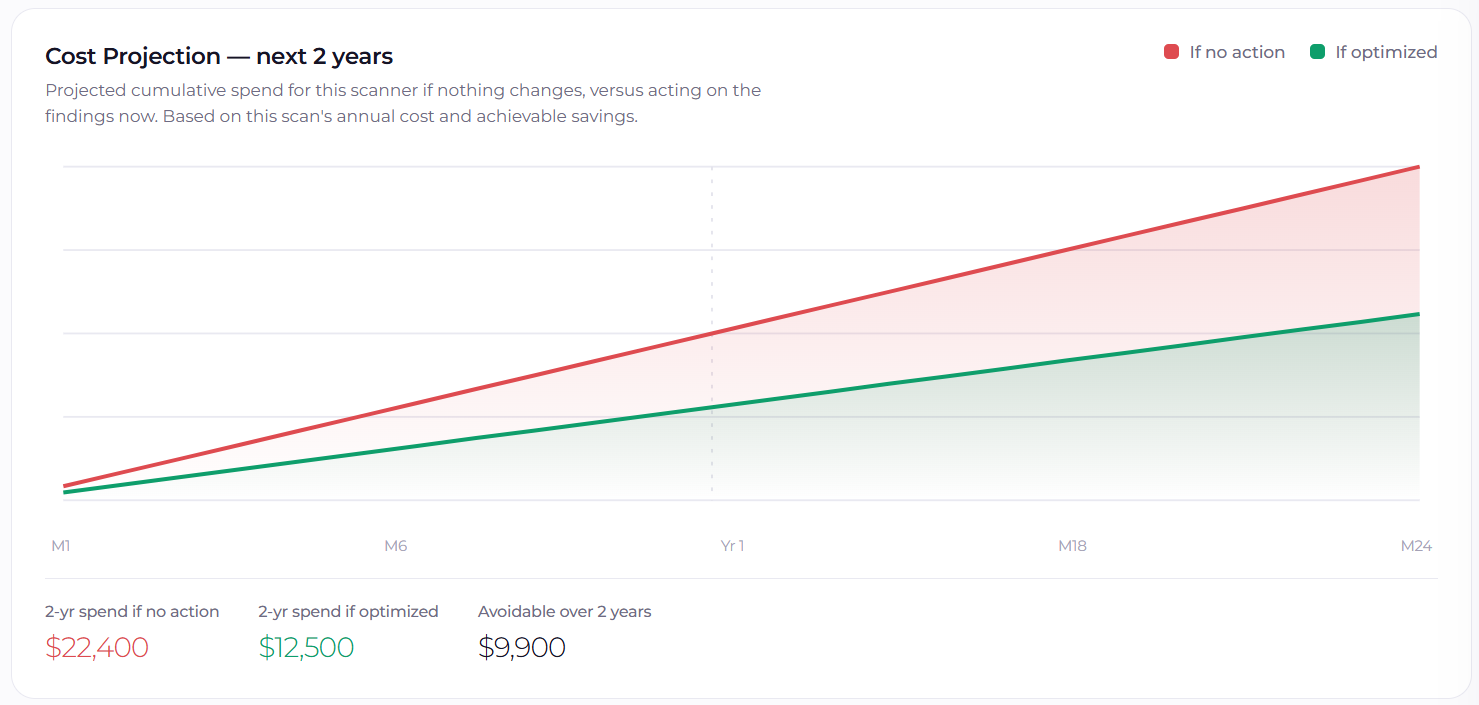
Each scanner plots cumulative spend if nothing changes against acting today — derived from the scan’s own annual cost and achievable savings, so the numbers tie out.
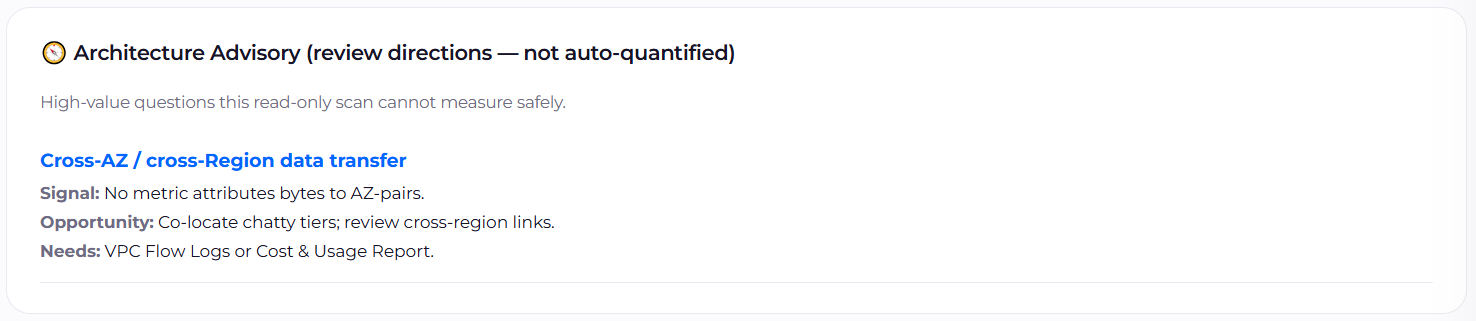
For questions a read-only scan can’t quantify — cross-AZ transfer, duplicate telemetry — we hand you the signal, the opportunity, and exactly what data would confirm it.
In and out. No footprint left behind.
Grant access with a scoped, read-only IAM role — no agents, no VPC peering, no data egress.
Sign up to issue a cryptographically unique ExternalID — your Confused-Deputy guard.
One-click CloudFormation stack, or paste the read-only policy manually.
We assume the role via STS and verify read-only access is in place.
Metadata collectors enumerate the estate and return a costed report in under 3 minutes.
GhostTrace reads one thing: configuration metadata — resource settings, tags, attachment state, and CloudWatch metrics. That's the entire granted scope, so your file contents, database rows, and live sessions stay yours alone.
Pay for what you hunt. One month at a time — nothing recurring.
The S3 scanner is free — audit your estate and see the savings first. Then put those savings toward a paid month when you want the other scanners. Each plan is a one-time payment for one month. No auto-renewal, no subscription locked to your card.
No card required.
Start freeFor a single team.
Get 1 month — $19For growing teams.
Get 1 month — $49For large estates.
Get 1 month — $99Agency accounts and white-label reporting are coming soon.
The waste was always there. Now it has a name and a dollar figure.
Connect a read-only role and get a deterministic, cost-quantified audit report in under three minutes.

GhostTrace is built and run by Owl Theory Labs, a cloud consultancy working across web, cloud and AI. If a report turns up more than you want to tackle alone, the same team that builds the scanners can help you act on it.